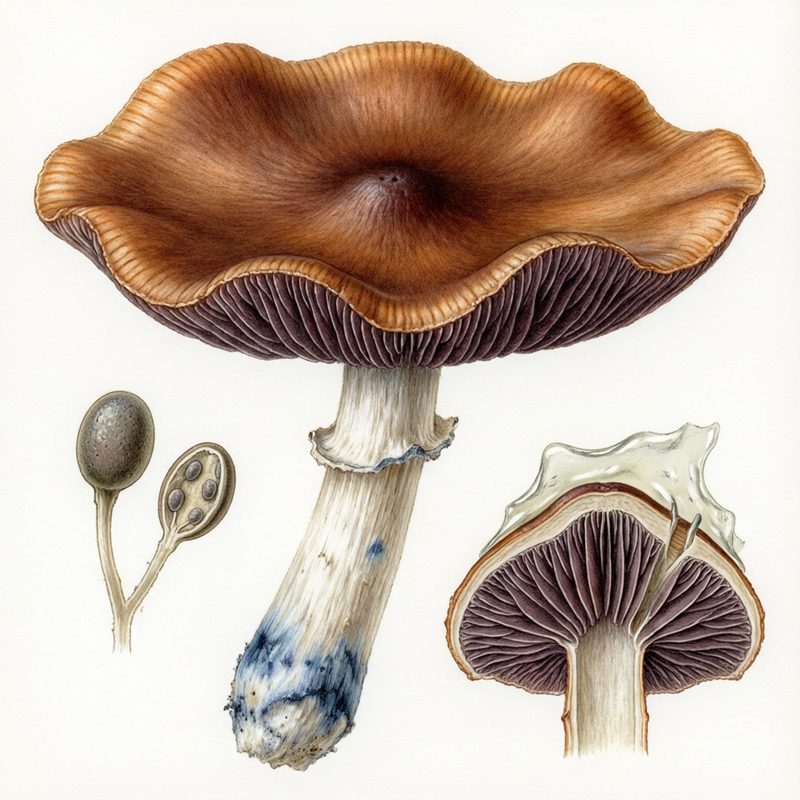
Wavy Cap
Distribution
Pacific Northwest of North America (Washington, Oregon, northern California), Western and Central Europe (UK, Germany, Netherlands, France, Austria, Switzerland). Likely introduced to Europe via wood chip trade. Also reported in New Zealand and parts of Canada.
Habitat
Saprotrophic on woody debris. Grows prolifically on wood chips, mulched plant beds (especially under rhododendrons), in urban parks, cemeteries, botanic gardens, city parks, racecourses, and housing estate landscaping. Strongly associated with deciduous wood chip mulch.
Season
Autumn through early winter (October to December in the Pacific Northwest, sometimes into January). In Europe, late autumn through winter. Fruits in large clusters, often in massive quantities. Triggered by temperature drop to 10-18C.
Toxin Type
psilocybin, psilocin
Symptoms
Similar to P. cubensis: nausea, dilated pupils, increased heart rate. Strong blue bruising reaction on handling (oxidized psilocin). More potent than P. cubensis, so smaller doses may cause intense effects. Risk of misidentification with deadly Galerina species.
Hallucinogenic Effects
Visual: Intense color enhancement particularly in blues and greens. Surfaces appear to flow, undulate, or ripple. Geometric patterns and fractal imagery on closed eyes. Objects may appear to breathe or pulse. Visual trails and tracers. Stronger visual intensity than P. cubensis at equivalent doses. Mental: Profound euphoria, deep introspection, philosophical insights, time distortion. Strong body high (body load) reported more than with P. cubensis. Enhanced empathy and emotional openness. At high doses: mystical experiences, ego dissolution, synesthesia. Timeline: Effects begin 30-60 minutes after ingestion, peak at 2-3 hours, total duration 4-6 hours. Noted for more pronounced body load.