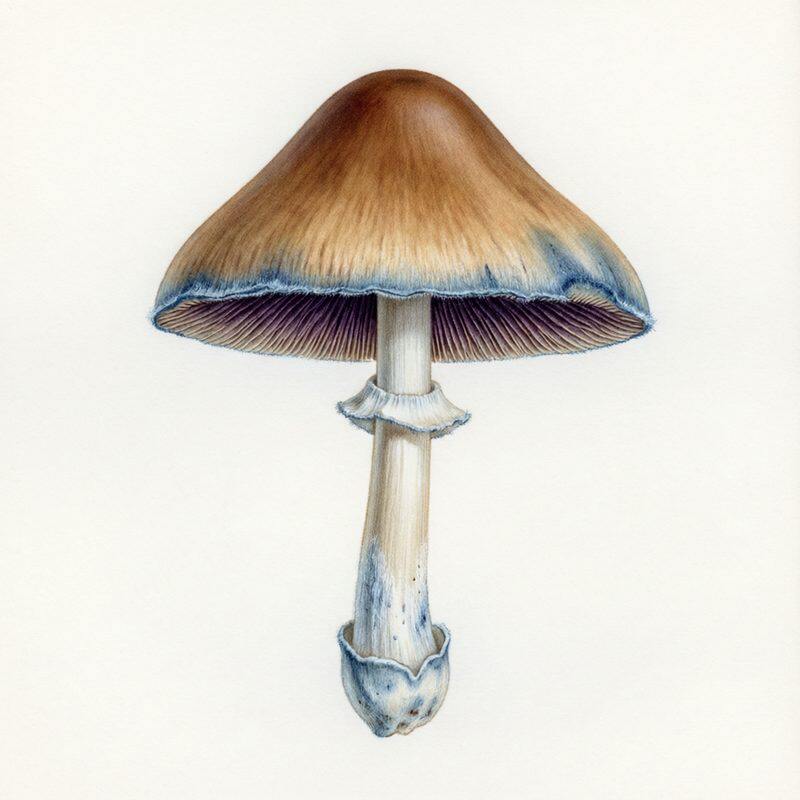
Flying Saucer
Distribution
Very limited natural range: primarily along the US Pacific coast near the Columbia River delta, north of Seaside, Oregon, and southern Washington state. Cultivated patches exist worldwide. Endemic to a small coastal region.
Habitat
Grows on deciduous wood chips and in sandy soils rich in lignicolous debris. Forms dense mycelial mats. Found in coastal dune grasses, Alder and Willow wood chip piles. Prefers sandy, well-draining coastal soils near the ocean.
Season
Late September through mid-November (until harsh frost). One of the latest fruiting Psilocybe species. Cold-tolerant, fruits at temperatures as low as 5C. Short season limited by first hard frost.
Toxin Type
psilocybin, psilocin
Symptoms
Extremely bitter taste. Pronounced nausea due to potency. Strong body load. Woodlover's paralysis (temporary leg weakness lasting hours). Dilated pupils, increased heart rate. Effects significantly more intense than other species due to high alkaloid content.
Hallucinogenic Effects
Visual: Extremely intense visual distortions. Surfaces ripple, flow, and morph dramatically. Vivid geometric patterns even at low doses with eyes open. Closed-eye visuals are intensely complex and detailed. Colors become hyper-saturated. Visual tracers and afterimages very pronounced. Reality may appear to dissolve or restructure. Mental: Profoundly intense psychedelic experience even at low doses. Deep mystical and spiritual experiences. Complete ego dissolution at moderate doses. Extreme time distortion. Enhanced introspection and philosophical insight. Considered to produce the most intense natural psilocybin experience. Can be overwhelming for inexperienced users. Timeline: Effects begin 20-40 minutes after ingestion, peak at 2-4 hours, total duration 6-8 hours (notably longer than other species). Famous for intense effects and long duration.