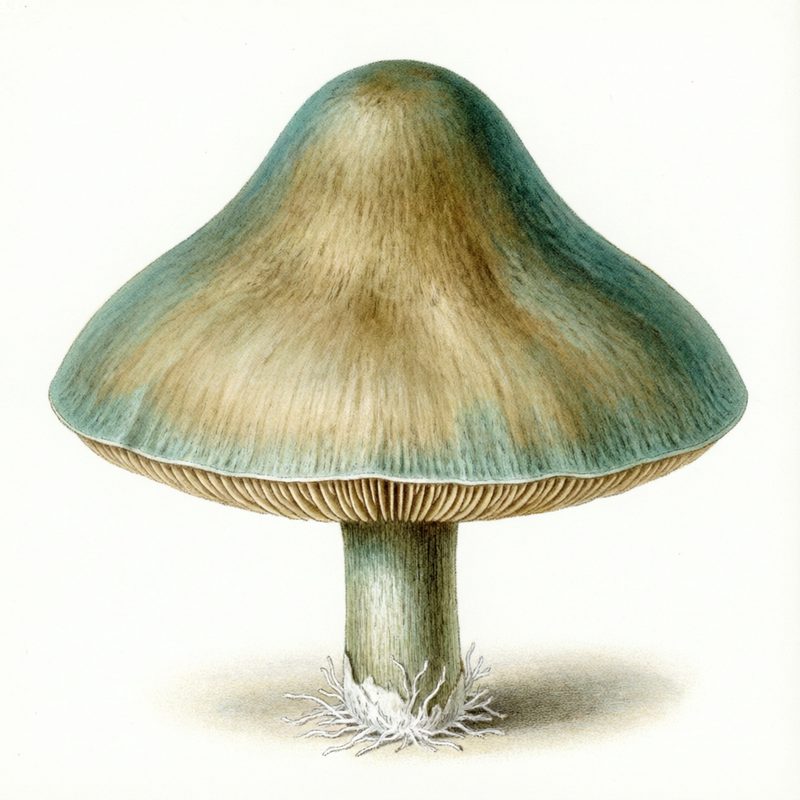
Aeruginascin Mushroom
Distribution
Central and Western Europe: Germany, Hungary, Czech Republic, France, Austria, Switzerland. Relatively rare and localized distribution. Found in urban and suburban areas as well as natural woodlands.
Habitat
Mycorrhizal with deciduous trees, particularly Tilia (linden/lime) trees. Found in urban parks, gardens, along tree-lined avenues, and in deciduous woodlands. Strongly associated with Tilia trees in urban settings. Grows in soil near host trees.
Season
Summer through early autumn (July to October). Fruits in warm conditions during the growing season. Associated with summer thunderstorms and heavy rainfall in urban park settings.
Toxin Type
aeruginascin (N,N,N-trimethyl-4-phosphoryloxytryptamine), psilocybin
Symptoms
Elevation in mood reported without typical hallucinogenic effects at lower doses. Mild psychoactive effects compared to Psilocybe species. Aeruginascin's metabolite binds 5-HT3 receptors (related to mood elevation and anti-nausea). Standard psilocybin symptoms possible from co-occurring psilocybin. EXTREME CAUTION: Many Inocybe species contain deadly muscarine.
Hallucinogenic Effects
Visual: Minimal visual effects at typical doses. Less visual distortion than Psilocybe species. The unique aeruginascin compound appears to produce primarily mood elevation rather than classic psychedelic visuals. Mental: Notable elevation in mood without strong hallucinogenic effects. The aeruginascin compound may produce an entourage effect when combined with psilocybin, potentially modulating the overall experience. Less well-studied than Psilocybe effects. May produce a uniquely pleasant, non-visual psychedelic state. The 5-HT3 receptor agonist activity of its metabolite may contribute to anti-nausea and mood-lifting effects. Timeline: Not well-documented. Expected to follow typical psilocybin-like timeline of 4-6 hours when effects are present, though effects are notably subtler.